Report of HEC on 26th June 2026

The Crisis

HEC is currently facing a major crisis – increasing numbers of universities facing threats of hundreds of compulsory redundancies and pension loss and slashing, cuts and closures, as well as the ongoing problems of casualisation and workloads. A BBC report has suggested 24 universities will go under. Insufficient finance, university mismanagement and prioritising new buildings and overseas campuses over staff have all played their role in this crisis. However, financial issues are not the only cause and even universities like Glasgow which are doing quite well financially are proposing austerity measures.


Taking Strong Action Now or …?

There is general recognition of the crisis and even of its main causes and potential solutions. However, there are two main perspectives on the action we need to take and these different perspectives dominated the discussion at HEC.


The perspective I support recognises that it is necessary to put pressure on our employers and the main way to do this is collective industrial action which involves the whole sector. Leaving individual branches to fight on their own is not the most effective approach and will leave the weaker branches to sink. This needs to be combined with putting pressure on government for fully funded HE out of taxation and returning to free education with living costs also covered. I also support the need for a long term strategy to build membership and our industrial strength and prevent future crises, but without immediate action to defend universities in crisis we will lose a lot of members, jobs and possibly also universities before we get to the point of implementing the long term strategy.


The other perspective, which unfortunately was shared by the majority of HEC members, focuses purely on the long term strategy and ignores the need for immediate action, including sector wide industrial action, to resolve the current crisis. This difference of views came out strongly in the discussion of the recommendations in the Committee Secretary’s report, the discussion of a strategy paper and discussion of a motion on industrial action.


Committee Secretary’s Report

The recommendations covered a consultative ballot on the 2% pay offer with a recommendation to reject; the negotiators to agree next steps, including any dispute negotiation meetings, with the other unions; and negotiations over the pay spine, contract types/casualisation, equality pay gaps, and workloads. An amendment to add to not delay industrial action to the recommendation on working with the other unions was ruled out of order. The reasons were unclear, though we were told this was already policy. There was some, discussion on including industrial action in the consultative ballot. While this could be positive, industrial action ballots need to be built for. The recommendations was passed, but there was no decision on when the consultative ballot would take place.


Strategy Papers

A strategy paper was presented by the chair and approved. While it recognised the major crisis facing HE, there were no suggestions for immediate action to resolve the crisis. Major wins were considered to be a new funding model for HE and regulation to support and enforce national bargaining. There was no mention of an agreement for at least a moratorium on redundancies or what the new funding model should cover, such as full funding of all costs and without the need for tuition fees.


Another longer draft strategy document was presented for information, but not as part of the same item and not discussed. While the aims include tackling the funding crisis and building collective strength, there is a lot about narratives and messaging and nothing about the need for moving to sector-wide industrial action as soon as possible to end the crisis. I would recommend members to respond to the ongoing consultation by noting that we need immediate action, including industrial action, not PR and to be given ‘narratives’ and ‘messaging’ that we know already. A paper reviewing the HE 2025 ballot campaign seemed to be aimed at discouraging further action rather than learning lessons to make subsequent action more successful.


Secretary of State Dispute

HEC has been working hard to implement the motion on a dispute with the Secretary of State and set up a working group. Two sets of legal advice were obtained and shared with the working group, whereas HEC was only told the conclusions from this advice. These stated that any action would have to be restricted to England and that a dispute with SoS over the redundancies crisis is not possible as against current law. HEC agreed recommendations to pause the dispute, including not to seek further legal advice, and to organise engagement events which would be aligned with other HEC strategy decisions.


Motion from Members

The single motion from HEC members, from Christina Paine with Marion Hersh and Suzy FitzPatrick seconding, called for a dispute about redundancies. There were also three amendments with two ruled out of order on unclear grounds. A challenge to include the amendment on calling a special sector conference and ballot on this dispute fell, as did the motion.


Call on Branches to Take Collective Action

It is problematical that HEC did not make any decisions which would lead to a ballot and industrial action or otherwise put real pressure on employers about the jobs crisis. However, it is members, not HEC, that are the union. Members can put motions to their branches to call a special sector conference to discuss action to resolve the crisis and if at least 20 are received with the same wording, then UCU is required to do this. Branches can also coordinate action and support each other, as well as continue to put pressure on HEC.

Report of NEC on 19th June 2026

General Secretary’s Report

This covered a lot of important issues, but left unclear what, if anything, the GS is going to do to prevent cuts, closures and job losses and advance real education and the connection between research and teaching. FE Sector Conference decisions covered responses to threats on redundancies, pay cuts and structural changes. A victory was also reported. New City College agreed to reinstate a dismissed rep. Congratulations to the branch and it is important this is publicised.


On HE there was a roundup of threats and branches taking action, largely to defend jobs. On HE pay the GS considered the UCEA offer of 2% disappointing, but is not supporting action. The political overview included the parliamentary group. The media section presented a Universities UK report that four of five vice chancellors are slashing jobs. The media response stated that mergers are not a solution, but did not propose strong action.


NEC members challenged the GS on a range of issues, but did not get any commitments to a strong response.


Review of Congress standing orders and rules

A paper from the president proposed draconian changes in response to a large number of motions being timed out. After extensive discussion NEC agreed with a significant minority opposed to put a number of recommendations for changes to members for feedback. However, with one exception, they would need to be agreed by a two thirds majority at Congress and we would strongly recommend members voting against if they get that far. The exception is the one proposal we support on reviewing the voting system. This should be carried out now to allow proposals for a change to be put to Congress 2027. However, the role of voting system problems in motions being timed out was not mentioned.


While the context of the paper and recommendations was not being able to debate all the motions, one of the proposals would lead to a reduction in the time given to Congress decision making with panel discussions, fringe meetings, social events (the latter two taking place already) proposed as well as official business.


The most far ranging and worrying change was the proposal to allow the rules to be amended by ballot rather than a two thirds majority on a rule change motion at Congress. Debating rule change proposals at Congress is important to give a good understanding of the issues and to reveal pitfalls that are not immediately apparent.


Other problematical changes included removing Congress’s ability to determine the agenda by challenging the report from the Congress Business Committee (CBC) and raising the threshold for challenges to the chair to pass from a simple to two thirds majority. It was suggested this would bring us more in line with other unions, but this is not a valid argument. UCU has

always been proud of being at the forefront and taking the lead. The large number of challenges to the CBC report could be reduced by clearer instructions to branches. It should also be noted that CBC excluded some motions that would not have been excluded in the past. However, we have the highest respect for CBC.


Campaign Strategy

Although wide ranging, including, for instance, climate and weapons, it seemed rather like a PR exercise with its focus on ‘narrative’ and ‘messaging’. It was, however, weak, on strong action to overcome the funding and jobs crisis and advancing our vision for education.


Other Issues

The time spent on the Congress proposals meant that all the motions were timed out. Particularly ironically this included a motion on a recall Congress, as well as two motions on casualisation (an issue of particular concern to members) and a motion on withdrawing from X. NEC noted the allocation of Congress motions to NEC committees and was told there would be an opportunity to discuss action to implement them at the next meeting. The equality strategy was noted. The proposal for the procedures for NEC elections (which comes to NEC each year) was agreed after a question on implementing the changes the rule change motions passed. Proposals for modifying the Rule 13/disciplinary offences procedure to implement Congress motions were agreed with minimal discussion.

Welcome to Austerity FOMO

by Rhys Machold & Sayantan Ghosal

Download this blog post as a PDF here.

As you will have heard in recent communication from our Vice Chancellor Andy Schofield on 23 June, despite on one hand noting that despite delivering “a modest surplus in the current financial year”, our University’s overall “financial environment is becoming increasingly challenging.” He explained that in this environment, the University Court has now approved a budget that will seek to maintain “a small underlying financial surplus” in order to ensure “the long‑term sustainability of the institution.” As he went on, achieving this goal “will require significant further savings across all areas of expenditure and each of our budgetary units”, which will in turn “inevitably” result in “implications for the size of our workforce, affecting both academic and professional services roles.” In other words, welcome to a new period of financial austerity.

We are told this austerity being undertaken not by design but out of material necessity itself resulting from “inevitable” dynamics that are far beyond our University’s control. It also has no clear timeframe or specific targets beyond at least ostensibly ensuring our institution’s viability and by extension the long-term “wellbeing of our colleague and student community”, at least those of us who are not implicated in plans for future redundancies.

This announcement is perhaps on its face, not entirely surprising. After all, we have seen countless other universities announce and begin to enact similar austerity plans across Scotland and the UK in recent years. These have been justified by references to a range of distinct but also overlapping crises, whether falling international student numbers, poor investment decisions, rising costs, etc. etc. Yet, in our case in Glasgow, however, despite our VC’s claim about the impending austerity being “inevitable” consequence of conspiring external factors facing our institution’s viability, it is rather less than clear what these ostensible factors actually are.

Below is an overview of the actual figures we currently have access to, which paint a rather different picture about our current financial environment:

  • Reserves: The University holds over £1.3 billion in unrestricted reserves, with £645.7 million in liquid funds — enough to run for more than 200 days without any income at all, well above the sector benchmark of 110–150 days. In addition, the university has a credit facility with banks of £200 million.
  • Growing income: Total income has risen continuously for a decade including through the recent dip in international student numbers, with tuition fee income alone rising by nearly £70 million in 2024–25 and research income rising by £18.8 million. The University has recorded an annual operating surplus for over a decade.
  • Low staff costs: The University’s staff costs as a proportion of income are among the lowest in the Russell Group — fourth lowest, above only Oxford, Cambridge, and Bristol.
  • Cautious borrowing: Existing debt of around £250 million was secured at below 3% interest with repayment deferred until the 2030s at the earliest. Unlike three other major Scottish universities, Glasgow is no danger of breaking its loan covenants (it has £44.4 million cushion in meeting even the most stringent one).

Nevertheless, there are indeed some elements about our financial environment, unrelated to staffing costs, which are cause for concern:

  • Capital Spend: Between now and 2040, annual capital spend is planned to be over £100 million+, double the historical average. A sinking fund to meet principal repayments beyond 2040 has been created. But there are no cuts planned in Glasgow’s anticipated capital spend.
  • Rising consultancy fees: Between 2019-2026, the University spent over £114 million on consultancy fees (data from FOI request by UCU Goldsmith).

Based on our own rigorous analysis of these publicly-available figures, we have an alternative diagnosis of what our University is facing. Rather than facing an external set of pressures beyond our control that are forcing our leadership to act responsibly, the ailment we face is something altogether different. We call this austerity FOMO. For the uninitiated FOMO is the abbreviation for “fear of missing out”, broadly defined as a worried feeling that one may miss out on exciting events that others are partaking in.

Based on the clear disjuncture between our VC’s austerity vision and the data we have access to about our University’s actually-existing financial position, it is hard to come to any other conclusion. It seems to us that rather than taking an accurate assessment our current financial situation and being encouraged by our relative, some might even say exceptional, strength within our sector within Scotland and the UK, our leadership instead seems to be worried that they might well miss out on the austerity gripping the broader higher education sector at the moment.

This threat is very real. The University of Glasgow is already laying-off people on open-ended contracts: 52 Associate Tutors at the School of Education are to be made redundant at the start of the semester, 35 of whom are on open-ended contracts.

It is imperative to challenge and contest the SMG narrative that staff cuts are inevitable because of declining PGT numbers. An alternative would be to minimize the decline in PGT revenue (and not just numbers) and focus on generating additional sources of revenue (commercial activities, industry collaboration, increased research income, new modules and teaching initiatives) by working with (and not against) faculty or adopting an ad hoc slash and burn approach to cutting costs devoid of any strategic thinking and consideration.

That the SMG are focusing on staff cuts is a management and political choice (i.e. Austerity FOMO). Other approaches can and should be explored in consultation with the staff and relevant unions.

Of course, exploiting political crises is nothing new. Nearly two decades ago Naomi Klein alerted us to this dynamic in her powerful book The Shock Doctrine, which traced the origins of what she called the rise of “disaster capitalism”. While fear is, no doubt, at work in austerity FOMO is clearly borne out of a fear on missing out the potential transformative force of disaster capitalism that Klein chronicles. Austerity FOMO is thus different from the general shock doctrine in at least one respect : it is not merely an attempt to exploit an external disaster that has already happened; rather it is an attempt to fabricate a crisis which does not yet exist, at least not in the form it is being presented.

It is for this reason that UCU Glasgow is calling on our membership to find ways to raise awareness about how austerity FOMO is being mobilized as the basis of a major assault on all of us as a choice rather than economic necessity. Only by drawing attention to the fictitious basis of this new wave of austerity that can we begin to develop a strong response to it. So we encourage you to get the word out! Speak to your colleagues and let it be known: we are being deceived into a crisis which is entirely made up and entirely avoidable! Facts matter and in this instance they are clearly on our side!

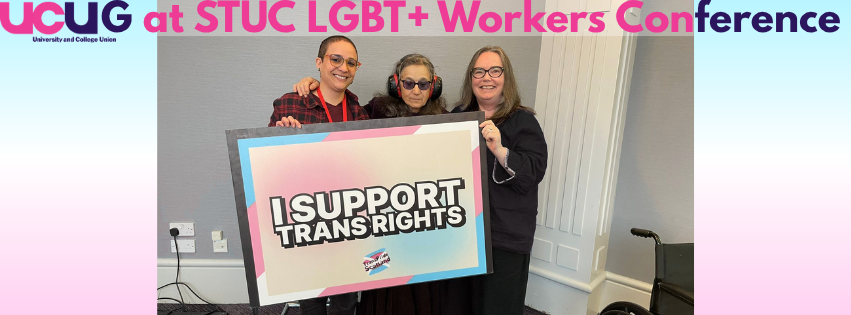
Report on 15th Annual STUC LGBT+ Workers’ Conference (2026)

UCUG at STUC Workers Conference. Members holding a sign "I support Trans Rights"Mariel Goulart, Marion Hersh and Sarah Currier (all Glasgow) UCU Delegates

Introduction and conference atmosphere

The 15th Annual STUC LGBT+ Workers’ Conference took place on Saturday 16th and Sunday 17th May 2026 at the Golden Jubilee Conference Hotel in Clydebank, Glasgow. The atmosphere was great – welcoming, energetic and genuinely supportive.

A standout moment was the panel session on Sunday morning featuring one of Scotland’s first trans MSPs. The panel included Oceana Maud (Equality Network / Scottish Trans), Zarith (Care 4 Calais) and Tammy Hymas (Policy Lead, TransActual). Hearing them speak about trans rights, asylum solidarity and grassroots organising was inspiring and a powerful reminder of why LGBT+ visibility in politics and trade unions matters. We also appreciated the workshops on ACE / ARO awareness and A People’s History of LGBT+ Liberation. A motion on Decriminalising sex work was remitted and all the other motions were carried.

Motions UCU was directly involved in

Our two motions on Trans Rights – Countering the Threats and Organising Against Reform and the Far Right in many ways encapsulated the two main themes of the conferences and both were composited (combined) with other motions.  The Advancing Trans and Non-Binary Rights Composite  reaffirms full support for trans and non‑binary workers. It notes that the Supreme Court ruling on “sex” has not changed legal protection for gender reassignment. It warns that employers might force trans workers to use disabled toilets instead of facilities matching their lived gender. The motion calls on the STUC LGBT+ Workers’ Committee to produce guidance on trans rights for members and to encourage affiliates to join demonstrations and events supporting trans rights.  Sarah spoke about our experiences organising locally in support of trans members.

The Tackling the Far Right composite condemns the rise of Reform UK and far right groups who weaponise anti‑trans and anti‑LGBT+ hate. It states that transphobia is part of the same harmful far right narratives attacking all minorities. The motion calls on the STUC LGBT+ Workers’ Committee to develop training for union reps and create resources on the far right origins of anti‑trans hate.  Marion spoke about the even greater threat from Reform getting into political power than their detestable violent attacks and the need to be active in countering them.

We also seconded a motion on Pride and Prejudice from the FBU which we had amended.  Marion spoke on the importance of Pride remaining political and non-commercialised.  Mariel spoke very movingly about the situation in Brazil to a motion from Usdaw on International Solidarity.

Next steps

UCU has a vital role in defending LGBTQ+ members against discrimination, harassment and far right hostility. Through collective bargaining, legal advice, rep training and active campaigning, we need to make sure that trans, non‑binary and all LGBTQ+ members are safe and supported at work. This conference showed again that a strong union presence, including UCU’s voice, is essential to turning policy into real protection for our members.  Our rights have advanced, but there continue to be threats which we need to overcome.  The current threats are the Supreme Court Judgement and EHRC guidelines and we need to be active in challenging them and ensuring our workplaces remain welcoming and provide appropriate facilities to trans, non-binary, intersex and gender non-conforming members.

Like many other delegations we took a photo with the Transpride banner (above) and hope to invite them to a branch meeting.  We would encourage other LGBTQ+ members to attend the conference next year.

If you are a UCU Glasgow member & you want to join the LGBT+ Subcommittee and/or the EHRC Working Group please email: ucug@glasgow.ac.uk

Safe but too safe: excessive prudence as a form of institutional self-harm?

UCUG Finance working group blog #1 May 2026ucu branch news

Safe but too safe: excessive prudence as a form of institutional self-harm?

The first in a planned series of blogs about university finances at Glasgow

We all know that Higher Education in Scotland and in the UK as a whole is in crisis, but this crisis is not evenly spread across the sector. The University of Glasgow’s Senior Management assure us that Glasgow’s finances are not under threat…yet, but we are seeing budgets verging on austerity. We are working in an environment of ever-increasing workload, not least because an effective recruitment freeze means departing colleagues are never replaced. Management renege on promised pay spine restructuring using the sector’s difficulties to justify successive below-inflation pay rises. Meanwhile, PhD studentships and personal research allowances are slashed and buildings and services are allowed to crumble around us taking their toll on morale and productivity. Fixed term contracts are not renewed, a “hidden” redundancy?  GTA budgets have been slashed. What impact will these cuts have on Glasgow’s ability to raise research funding? How will individual subject areas and the University maintain their global rankings?

UCUG set out to understand the University finances, with expert advice, to discover whether you should be worried – you may be surprised by what we learned.

University finances as for any large organisation are complex and opaque to those who are unfamiliar with them. There are many accounting games that can be played and some staggeringly large numbers involved when the value of the physical assets (buildings & land) and endowments (money given for some specific purpose) are considered. However, the current financial health of the University is dependent on the balance between its income (largely from teaching, grants for research and from government) set against its expenditure (staff salaries, infrastructure maintenance, new buildings & interest on borrowing). Over time an institution can build up reserves when income exceeds expenditure (called a surplus) or eat into its reserves when in deficit. The “available funds” are a university’s equivalent of cash in the bank – money that they can use to cover unexpected dips in income. A yearly surplus and a comfortable reserve are indicators of sound financial health, but excessive surpluses and reserves mean that the income is not being put to good use by hiring enough staff to teach the students and carry out the research that are the University’s missions.

Glasgow riding high in stormy waters?

The situation at Dundee, as well as recent press coverage of Edinburgh and Strathclyde, feeds a narrative that the HE crisis is existential for Scotland’s universities old and new. However, the University of Glasgow is in a very strong financial position with turnover of over a billion pounds last year, has increased annual income continuously for the last 10 years (including the last two when international student numbers declined), and reported £1.3 billion in unrestricted reserves in 2024-25.

Glasgow’s annual report 2024/25, p. 30 notes that: “Available funds (cash and cash equivalents and investments) increased by £7.5m to £645.7m (2023-24 £638.2m).” These are liquid “reserves” that can be utilised to meet demand for payments. Since the university also has access to revolving credit facilities providing up to a further £200m, it is well-positioned against shocks. If the University’s income dried up overnight, these funds would allow it to run for over 200 days (“liquidity days”) before dipping into its overdraft. At present, most universities aim to have 110-150 of “days” of liquidity and only when this falls below 60 is it likely to cause issues.

This scale of reserves, credit and endowment mean the university could withstand severe income losses over multiple years before it came anywhere close to Dundee’s situation.

Glasgow’s income from overseas students increased markedly in 2024/25, when others saw severe downturns. An additional 1500 international students registered last year driving the overall increase in income recorded for 2024-25: tuition fees increased by £69.8 million as part of a total increase income of £93.2 million with increased in research income (£19.2 million) being the other significant component.

Although the annual report suggests that 2024-25 PGT numbers were lower, it also notes that income met or exceeded budget forecasts. Both PGT numbers and income are in a volatile state and downward trend, but the degree of this decline matters. An overly negative assessment of the downside (as happened for the last two years in a row) leads to aggressive cuts and damaging savings targets.

Staff costs as a proportion of income show UoG is several %age points below the sector average (HESA DT031 Table 1, Academic years 2015/16 to 2024/25). This ratio was the fourth lowest of all Russell Group universities above only Cambridge, Oxford and Bristol (and noting that the first two of these have such high income their staff cost ratios are consistently low compared to other RGs).

Prudent borrowing at low interest rates is another feature of Glasgow’s current financial position. In the past the University borrowed roughly £250m at interest rates below 3% with capital repayment deferred until the end of the next decade at the earliest (2024-25 financial statement). This is the kind of mortgage deal that you would kill for.

The dangers of excessive prudence: Money in the bank is money not working for the institution

Large chunks of the University’s income depend on its reputation.

  • The Research Excellence Grant from SFC (£53.6m in 2025-26 https://www.sfc.ac.uk/publications/university-final-funding-allocations-2025-26/) depends on performance in REF combined with research power, which quantifies the number of staff and PhD students engaged in research.
  • Overseas fee income depends on particular metrics of the University’s reputation such as the QS World University Rankings. Being in the top 50 or top 100 has a dramatic impact on how keen overseas Governments and Scholarship funders are to send students to Glasgow.

The University is also a registered charity and whether it can justify its reserves level with its charitable purpose is a theme we expect to cover in a later blog.

Spending too little on staff and their environment hurts morale & productivity as well as delivering a less good student experience. We wouldn’t argue for more shiny new buildings but research & teaching staff time spent dealing with water (and worse) damage from leaking drains & roofs, with collapsing ceilings, and shivering in winter and boiling in summer due to failed heating or air conditioning is not time spent writing 4 star outputs or delivering an excellent student experience.

QS rankings depend on the opinions of others who know us. Will PGT numbers and income be negatively affected by current austerity measures? How will cuts to personal research allowances and recruitment freezes impact on the University’s ability to increase research income? Do your invited seminar speakers remember their visit to the University with envy or because they had to trek from building to building to meet colleagues in the same School before walking across campus in the rain to a randomly allocated lecture room with half functioning projectors and a disgusting toilet next door?

Questions you should ask in staff meetings

What specific savings target is my College/School/Service being asked to make this year and next year?

Are you as Head of School/College/Service satisfied with the assumptions underlying the need to make this level of savings?

Welcome to New UCU Glasgow Members!

New UCU Glasgow members meeting branch officers and reps over lunchWe’ve had a strong start to the academic year with our first general meeting and a welcome lunch for those of you who’ve recently joined UCU Glasgow! As we head into balloting for industrial action (opening October 20th), it’s as important as ever to build our organising power. Over the next two weeks, we are inviting members to get involved in getting the vote out, to organise against the far right, and to meet one another at our LGBTQ+ social – all are welcome! Contact ucug@glasgow.ac.uk for more information.

And here are a few more ways to get involved:

Submit a Motion to the next General Meeting!
 
The next General Meeting will take place on ​Wednesday 29 October 2025. Members are encouraged to submit motions about issues that you care about, suggesting actions that you want the branch to take, to be voted on democratically by other members. You can then also be involved in enacting the proposals made in the successful motions! If you’d like to submit a motion to our General Meeting, the deadline to do so is Thursday, 23 October 2025 at 11:00am. You can find more information on submitting local motions on our webpage.
Become an Area Rep!
As a UCU Glasgow Area Rep, you are often the first point of contact for members in your Subject, School or Unit. You might hold meetings for members in your area, or members might approach you one-on-one for advice. Most often you would direct these members to the branch’s Casework Coordinator. UCU Glasgow has a big supportive network of Area Reps who get together 1-2 times each semester to check in with one another about issues across their areas. Check the Area Reps webpage for vacancies.
Become a Caseworker!
 
UCU Glasgow has a team of experienced and trained representatives who undertake casework. These are members who provide support, advice and representation to individual members on employment related difficulties. There is ongoing support for caseworkers in the branch, from new caseworkers shadowing those with more experience, to regular casework catchups, to specialised surgeries for particular policies that come up in multiple cases. We currently have a high load of incoming casework requests and urgently need more caseworkers. Please contact ucug@glasgow.ac.uk about upcoming casework training (more information below) or for more information on becoming a caseworker.
 
Join a Subcommittee!
 
There are numerous active subcommittees within UCU Glasgow, including Anti-Casualisation; Disabled, Neurodivergent, and Deaf Members; Equalities; LGBTQ+; Migrant Members; and PGR Members. All of these subcommittees welcome new members! Two newly formed working groups are particularly keen to recruit – the Finance Working Group, which aims to better understand and inform members about university finances; and the EHRC Working Group, whose remit is to respond to updates of the EHRC Code of Practice following the Supreme Court judgement on the definition of ‘sex’ in the Equality Act 2010. To join, please contact ucug@glasgow.ac.uk or to the subcommittee conveners directly.
Join the Branch Committee!
UCU Glasgow, just like UCU nationally, is a democratic member-led organisation. Decisions about strategy, policy and direction are made by members in General Meetings. The Branch Committee then meets regularly and organises around the decisions taken by members at General Meetings. At our last AGM, you elected committee members for the coming academic year, but there are still several vacancies that need to be filled:
  • President
  • Organising Officer
  • Communications Rep
  • College of Arts & Humanities Rep
We are also short of second reps in some areas:
  • College of MVLS Rep
  • College of Science and Engineering Rep
  • University Services Rep
  • GTA Rep
  • PGR Rep
For more information on what these roles entail, or to express interest in joining committee, please contact ucug@glasgow.ac.uk.
Upcoming training for UCU reps:
Thinking of becoming a caseworker, area rep, H&S rep, or committee member? UCU is offering three upcoming training courses to get you started! “An introduction to casework” is a one-day course that sets you up with the tools you need to start representing your fellow UCU members as a caseworker. As a three-day course, “Reps 1” goes into more depth on casework, as well as other responsibilities of union representatives, equipping you to confidently take on area rep or committee member roles. Finally “H&S 1” is for existing UCU reps who are interested in furthering their training to become an H&S rep. Please let us know if you would like to apply to either training course or if you have any questions that would help you to decide which course is right for you.

Solidarity with Serbian students & academics

The University and College Union Glasgow (UCUG) stands in solidarity with Serbian students, academics and the wider movement protesting government corruption and Aleksander Vučić’s presidency. We are gravely concerned at the violent suppression of demonstrators which obstructs their democratic right to protest.
Student-led protests initially emerged in response to the collapse of the Novi Sad railway canopy which killed 16 people. Protests have spread across the country as people demand government transparency, accountability and full implementation of the rule of law.
Protestors have been met with insults and intimidation. Journalists have been subject to threats of physical violence for covering the movement. A smear campaign directed at the University of Belgrade’s rector escalated into a full-scale campaign by pro-regime figures calling for his arrest. These attacks against citizens exercising fundamental democratic rights are designed to silence critical voices and undermine academic autonomy.
The alleged use of an illegal sonic weapon at a demonstration on March 15 was intended to incite fear and undermine the right to assembly as well as presenting a risk to life with the panic it caused.
We echo the call made by Serbian academics and students for Serbian authorities to conduct a transparent investigation into the events of the protest and to hold accountable those responsible for any use of unlawful means against demonstrators. We urge the international academic community to share this call and affirm our commitment to the right to protest.

Solidarity with Professor Joseph Daher 

UCU Glasgow stands in solidarity with Professor Joseph Daher who has been denied a renewal of his contract as a visiting professor at the University of Lausanne (UNIL) despite his course being scheduled for the next term and his supervision of Master’s students.

Prof Daher has been subject to a smear campaign from French- and German-speaking Swiss press in connection with his defence of fundamental human rights and his commitment to supporting the demands of UNIL students mobilized around the Palestinian cause. UNIL has chosen to act punitively instead of affirming their stance for freedom of academic expression.

As Prof Daher notes “The arbitrary measures against me by the UNIL management are indeed part of a more general political context of pressure, repression and criminalization against academics and individuals engaged in solidarity with the Palestinian cause and with the defence of the fundamental rights of the Palestinian people.”

This repression has been noted in our own academic institutions where we have witnessed a surge in reports at Higher Education institutions across the UK of threats of disciplinary action against student activists and shutdown of student societies involved in the pro-Palestinian movement.

This has included recent actions at the University of Glasgow where students were banned from campus for participation in protest – now revoked – and the unlawful dismissal of staff as we have seen in the landmark case of Professor David Miller at the University of Bristol.

We ask our members and all those in academia to stand against these tactics of intimidation and sign this petition calling for Prof Daher’s immediate reinstatement.


Solidarity letter with student protesters

Today, UCU Glasgow sent the following letter to the Principal at the University of Glasgow.
Dear Principal and Deputy Vice-Chancellor,
We are writing to voice our support for peaceful protests in solidarity with Palestine at the University of Glasgow, whose Senior Management and Court has chosen to set itself up in opposition to the clear, longstanding will of its students and staff by choosing to continue to invest in and profit from the arms trade.
Such deliberate acts by the governing body of the university will inevitably inflame tensions at such a difficult time.
We therefore wish to convey our deep concern regarding the punitive interim measures taken against students recently engaged in protest actions on campus (by banning them from campus, interfering with their ability to study). We urge that you revoke them and refrain from further disciplinary action against students engaged in peaceful protest on campus.
We note the actions at Glasgow take place during a surge in reports at Higher Education institutions across the UK of threats of disciplinary action, shutdown of student societies, and expulsion of students involved in the pro-Palestinian movement.
We are deeply troubled by such measures against students both at Glasgow and across the sector which amount to an attack on the right to freedom of speech.
Universities are based on values of freedom of expression and sites of political debate and, as such, should be facilitating rather than restricting the right to protest. Such attacks come at a moment when we celebrate the ceasefire in Gaza. However, a ceasefire cannot undo the immense losses suffered nor the continuing occupation and ongoing threats to Palestinian land and people. We will continue to support  protests to end the complicity of the University of Glasgow in the ongoing genocide in Gaza.
UCU Glasgow Committee

UCU elections 2025

More info here: https://www.ucu.org.uk/article/13734/UCU-UK-elections-2024-25

UCU has a national executive committee, elected by the union’s members. Elections take place annually. Ballots to elect Trustees, Officers and National Executive Committee members open 27 January 2025. These elections include the post of UCU Scotland President and UCU Scotland Secretary.

A list of candidates is available here: https://www.ucu.org.uk/article/13734/UCU-UK-elections-2024-25

You can watch the hustings which took place on 5 March 2025:

https://www.ucu.org.uk/article/13899/UCU-election-hustings-2025

If you have not received a ballot paper yet, you can request a new one by clicking here. You might not have received your ballot if you moved recently and have not updated UCU of the change in your postal address. If this is the case, please amend your membership record online (you will have to register if you haven’t used myUCU in the past) or by emailing your new address to ucug@glasgow.ac.uk.

The UCU Glasgow inbox has received various election communication from candidates, all of which are copied below. Please note that these are NOT ENDORSEMENTS, just a collation of materials we have received. UCU Glasgow does not endorse candidates in internal elections.

If you are a candidate and would like for your materials to be displayed here, please email ucug@glasgow.ac.uk.


Vice President (Higher Education) – Rhiannon Lockley

Dear UCU member,
Solidarity to you and to your UCU branch.
I am  getting in touch because I’m standing for election to Vice President of UCU. I want to let you know about my campaign, and ask you for your vote. This is a postal election, and ballot papers will be arriving shortly.
I know UCU members are very busy. Workload is growing, there are threats to our working conditions, and we face cuts across the university sector on a new and frightening scale. Thank you for what you give to UCU, whether that is attending meetings to give your views, taking part in votes, supporting members with casework or giving your time as a rep or committee member. I know how busy our branch team at BCU are and I am sure your branch is too.
Voting in UCU elections is central to facing the problems hitting our sector. I believe trade unions work best with unity and mutual respect, which come from understanding and following the principles of union democracy. 
 
As UCU members we all care about the problems we and our colleagues face, and we can all offer something together to tackle these. We don’t always agree, but we can support each other in making and acting on collective decisions to take on the challenges we face together.
 
The Vice President/President plays a central role in how members work with each other, acting as Chair of the HE sector and then the Union. As a very experienced UCU Chair I would use the skills I have developed over time in UCU to get business heard, to make sure all members are included and welcomed, and to facilitate democratic decision-making by members. 
You can find out more about my campaign, including endorsements from members across our regions, nations and sectors, as well as colleagues from other unions, here: Rhiannon Lockley UCU VP election site
Vote Rhiannon Lockley (she/her) for UCU Vice President (Higher Education): ballots are live 27th January till 3rd March 2025
rhiannonforucuvp.wordpress.com
Please do consider voting for me and for Deepa Govindarajan Driver for Honorary Treasurer. I have put together a list of candidates I support who are standing in the 2025 elections here:  List of candidates I support in the 2025 UCU elections . They are not all members I always agree with in terms of tactics, but they are all committed to upholding the democracy of UCU: this is vital for us to function as a union able to take on the challenges we face.
Thank you again for supporting UCU and for taking the time to hear from candidates. Whoever you vote for, please do vote.


Trustee – Mike Barton

The UCU elections for the Vice President, Honorary Treasurer, Trustees and the National Executive Committee have opened and members are now receiving ballot papers.

I am standing for election for the position of trustee, and I would appreciate it if you would circulate my election material to all of your members for their consideration: https://bit.ly/MikeBarton4UCUTrustee.

This is in line with UCU’s policy to encourage the circulation of information about all candidates standing in elections.

In addition to circulating my election material, I would very much welcome the endorsement by your branch or region of my candidacy if you feel you are able to do so.

In solidarity,

Mike Barton

mikejbarton@gmail.com

UCU Scotland President – Grant Buttars

https://grantbuttarsucu.wordpress.com/2024/12/04/election-address-2025/ 

I am standing for the role of UCU Scotland President.  At present, I am UCU Scotland Vice President and this is my third term on UCU Scotland Executive, having also served 2 terms as an ordinary-elected member. I also chair UCU Scotland Education Committee.

I am also separately elected to NEC, sitting on HEC and Education Committee, and previously on ROCC. I also sit on Academic Related Professional Staff (ARPS) Committee.  I have worked as an archivist at the University of Edinburgh since 2001. Between 2018 and 2023, I was Branch President at Edinburgh, where I have also served as Communications Officer and as an Ordinary Committee member.  I am currently branch ARPS rep.  I bring knowledge and expertise of all levels of union work to the role of President.

It is incumbent on anybody holding elected office within the union to represent members and to hold power to account on behalf of members.  The power we hold as elected representatives is loaned to us by our members and is exercised on their behalf. If we see the union not functioning as it should, we must not be silent.

Anybody in elected office has the responsibility, when acting in that capacity, to represent the policy of the union and not engage in activity contrary to such policy.  That is not to say we are merely empty vessels with no opinions of our own and that dissent should be avoided.  I am an unapologetic socialist and these are my guiding principles. In appropriate fora I will argue and advocate from that position.  However, when representing our union as Scotland President, I will always put democratically agreed union policy first.

In the current crisis, with challenges around cuts and redundancies affecting every branch directly or indirectly, it is more important than ever that we fight back together, building solidarity with our fellow campus unions and our students.   Our strength comes from our numbers as a collective.  Atomised fights only benefit the bosses.

A trade union must be an exemplary employer and nurture within itself the same values and principles we demand of employers, government and others.  The ongoing disputes between UCU and its staff cast a very dark shadow upon all of us.  UCU staff are workers just like us and I reiterate my solidarity with them.  These disputes must be resolved satisfactorily without delay and likewise the one with Black Members Standing Committee with which they are entwined.  A union cannot properly fight for equality for its members with this issue unresolved.


UCU Scotland Secretary – Carlo Morelli 

https://uculeft.org/carlo-morelli-2/ 

Dundee University is at the centre of the storm over the funding of higher education
in Scotland. We have just successfully balloted for industrial action to save hundreds
of jobs due to a projected £30m deficit. As a member of the University at Dundee
and current Honorary Secretary for UCU Scotland I understand the need to ensure
branches fight redundancies and cuts but also ensure UCU Scotland gives its full
backing to branches resisting cuts.

Save Higher Education

Half of UK universities are cutting jobs. This includes many in Scotland. The
existence of the sector is under threat. Marketisation in Scotland is driven by
managements who share the group think of forcing debt via maintenance loans for
home students and exploiting international and rUK students’ tuition fees.
Simultaneously, the racist ‘hostile environment’ consciously used racism to
undermine the University sector.
Attempts to leave branches to fight these cuts institution by institution weakens us.
We need a UK-wide and Scottish-wide campaign to save HE, against job cuts and
end the racist environment. Unity is our strength. Unity can build a campaign to drive
the market out of education.
As Honorary Secretary for UCU Scotland I made the case for a lobby of the Scottish
Government and encouraging branches to ballot for industrial action when facing job
cuts.

Stand Up To Racism

Trump, Farage and the rise of fascism in Europe means we must place anti-racism
central to our union and workplaces. Racism is designed to scapegoat minorities and
divert attention from where the problems in our society originate. No immigrant is
illegal, and universities should stop policing immigration through draconian
monitoring and reporting on students and staff. I have been a supporter of the Sheku
Bayoh campaign since the start and stand up for students facing racism Blind
student facing deportation says university reneged on support | University of Dundee – The Guardian

USS and pensions

I was a USS negotiator during the 2018-19 strike. Five years of strike action shows
we can win. I am currently leading the campaign in the USS Advisory Cttee to
ensure cohabiting relationships are recognised for automatic survivor pensions. As
an NEC member I will continue to focus attention on threats to the Scottish TPS and
USS. I support our union’s policy on decarbonising and decolonising our pension
schemes.

Equality

Equality continues to be under attack. I am committed to ensuring equality remains
central to UCU Scotland. I will always support members standing up for trans-rights,
facing threats of internal complaints or employment tribunals.
I am a strong ally of my transrights and all LGBT+ siblings. I don’t believe we are
stuck as human beings by our DNA and hold strongly to the analysis of the social
model arising out of the disability movement, that it is society that creates structures
for disadvantage and oppression not our biology.

Palestine and Academic Boycott

I welcome the ceasefire in Gaza, hope it holds but fear for the lives of Palestinians
and others in the West Bank, Lebanon and Syria. Israel is an apartheid state and
universities in Scotland are legally complicit in genocide in Gaza, via their
investments and engagement with Israeli Universities. The IHRA definition facilitates
the clamp down on student protest and pro-Palestinian voices. It hinders rather than
supports the campaign against antisemitism due to its false conflation of antizionism
with antisemitism. UCU Scotland should continue its work on identifying with and
solidarity with Higher Education in Palestine. We can all play our part by individually
refusing to the Academic Boycott of Israeli Universities.

Trade union service

  • Chair of USS Advisory Committee: past USS negotiator on USS JNC.
  • UCU Scotland Honorary Secretary NEC member: previously UCU Scotland
  • President & UK-wide elected member for 6 years.
  • Member of Dundee UCU Committee for over 20 years & past president
  • Delegate to UCU Congress, STUC and TUC
  • Member of UCU Left and Stand Up To Racism
  • Senior Lecturer in Economics, Dundee University