Report on 15th Annual STUC LGBT+ Workers’ Conference (2026)

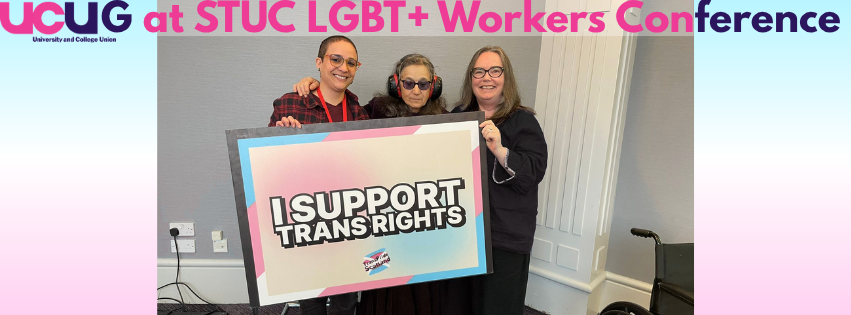
UCUG at STUC Workers Conference. Members holding a sign "I support Trans Rights"Mariel Goulart, Marion Hersh and Sarah Currier (all Glasgow) UCU Delegates

Introduction and conference atmosphere

The 15th Annual STUC LGBT+ Workers’ Conference took place on Saturday 16th and Sunday 17th May 2026 at the Golden Jubilee Conference Hotel in Clydebank, Glasgow. The atmosphere was great – welcoming, energetic and genuinely supportive.

A standout moment was the panel session on Sunday morning featuring one of Scotland’s first trans MSPs. The panel included Oceana Maud (Equality Network / Scottish Trans), Zarith (Care 4 Calais) and Tammy Hymas (Policy Lead, TransActual). Hearing them speak about trans rights, asylum solidarity and grassroots organising was inspiring and a powerful reminder of why LGBT+ visibility in politics and trade unions matters. We also appreciated the workshops on ACE / ARO awareness and A People’s History of LGBT+ Liberation. A motion on Decriminalising sex work was remitted and all the other motions were carried.

Motions UCU was directly involved in

Our two motions on Trans Rights – Countering the Threats and Organising Against Reform and the Far Right in many ways encapsulated the two main themes of the conferences and both were composited (combined) with other motions.  The Advancing Trans and Non-Binary Rights Composite  reaffirms full support for trans and non‑binary workers. It notes that the Supreme Court ruling on “sex” has not changed legal protection for gender reassignment. It warns that employers might force trans workers to use disabled toilets instead of facilities matching their lived gender. The motion calls on the STUC LGBT+ Workers’ Committee to produce guidance on trans rights for members and to encourage affiliates to join demonstrations and events supporting trans rights.  Sarah spoke about our experiences organising locally in support of trans members.

The Tackling the Far Right composite condemns the rise of Reform UK and far right groups who weaponise anti‑trans and anti‑LGBT+ hate. It states that transphobia is part of the same harmful far right narratives attacking all minorities. The motion calls on the STUC LGBT+ Workers’ Committee to develop training for union reps and create resources on the far right origins of anti‑trans hate.  Marion spoke about the even greater threat from Reform getting into political power than their detestable violent attacks and the need to be active in countering them.

We also seconded a motion on Pride and Prejudice from the FBU which we had amended.  Marion spoke on the importance of Pride remaining political and non-commercialised.  Mariel spoke very movingly about the situation in Brazil to a motion from Usdaw on International Solidarity.

Next steps

UCU has a vital role in defending LGBTQ+ members against discrimination, harassment and far right hostility. Through collective bargaining, legal advice, rep training and active campaigning, we need to make sure that trans, non‑binary and all LGBTQ+ members are safe and supported at work. This conference showed again that a strong union presence, including UCU’s voice, is essential to turning policy into real protection for our members.  Our rights have advanced, but there continue to be threats which we need to overcome.  The current threats are the Supreme Court Judgement and EHRC guidelines and we need to be active in challenging them and ensuring our workplaces remain welcoming and provide appropriate facilities to trans, non-binary, intersex and gender non-conforming members.

Like many other delegations we took a photo with the Transpride banner (above) and hope to invite them to a branch meeting.  We would encourage other LGBTQ+ members to attend the conference next year.

If you are a UCU Glasgow member & you want to join the LGBT+ Subcommittee and/or the EHRC Working Group please email: ucug@glasgow.ac.uk

Safe but too safe: excessive prudence as a form of institutional self-harm?

UCUG Finance working group blog #1 May 2026ucu branch news

Safe but too safe: excessive prudence as a form of institutional self-harm?

The first in a planned series of blogs about university finances at Glasgow

We all know that Higher Education in Scotland and in the UK as a whole is in crisis, but this crisis is not evenly spread across the sector. The University of Glasgow’s Senior Management assure us that Glasgow’s finances are not under threat…yet, but we are seeing budgets verging on austerity. We are working in an environment of ever-increasing workload, not least because an effective recruitment freeze means departing colleagues are never replaced. Management renege on promised pay spine restructuring using the sector’s difficulties to justify successive below-inflation pay rises. Meanwhile, PhD studentships and personal research allowances are slashed and buildings and services are allowed to crumble around us taking their toll on morale and productivity. Fixed term contracts are not renewed, a “hidden” redundancy?  GTA budgets have been slashed. What impact will these cuts have on Glasgow’s ability to raise research funding? How will individual subject areas and the University maintain their global rankings?

UCUG set out to understand the University finances, with expert advice, to discover whether you should be worried – you may be surprised by what we learned.

University finances as for any large organisation are complex and opaque to those who are unfamiliar with them. There are many accounting games that can be played and some staggeringly large numbers involved when the value of the physical assets (buildings & land) and endowments (money given for some specific purpose) are considered. However, the current financial health of the University is dependent on the balance between its income (largely from teaching, grants for research and from government) set against its expenditure (staff salaries, infrastructure maintenance, new buildings & interest on borrowing). Over time an institution can build up reserves when income exceeds expenditure (called a surplus) or eat into its reserves when in deficit. The “available funds” are a university’s equivalent of cash in the bank – money that they can use to cover unexpected dips in income. A yearly surplus and a comfortable reserve are indicators of sound financial health, but excessive surpluses and reserves mean that the income is not being put to good use by hiring enough staff to teach the students and carry out the research that are the University’s missions.

Glasgow riding high in stormy waters?

The situation at Dundee, as well as recent press coverage of Edinburgh and Strathclyde, feeds a narrative that the HE crisis is existential for Scotland’s universities old and new. However, the University of Glasgow is in a very strong financial position with turnover of over a billion pounds last year, has increased annual income continuously for the last 10 years (including the last two when international student numbers declined), and reported £1.3 billion in unrestricted reserves in 2024-25.

Glasgow’s annual report 2024/25, p. 30 notes that: “Available funds (cash and cash equivalents and investments) increased by £7.5m to £645.7m (2023-24 £638.2m).” These are liquid “reserves” that can be utilised to meet demand for payments. Since the university also has access to revolving credit facilities providing up to a further £200m, it is well-positioned against shocks. If the University’s income dried up overnight, these funds would allow it to run for over 200 days (“liquidity days”) before dipping into its overdraft. At present, most universities aim to have 110-150 of “days” of liquidity and only when this falls below 60 is it likely to cause issues.

This scale of reserves, credit and endowment mean the university could withstand severe income losses over multiple years before it came anywhere close to Dundee’s situation.

Glasgow’s income from overseas students increased markedly in 2024/25, when others saw severe downturns. An additional 1500 international students registered last year driving the overall increase in income recorded for 2024-25: tuition fees increased by £69.8 million as part of a total increase income of £93.2 million with increased in research income (£19.2 million) being the other significant component.

Although the annual report suggests that 2024-25 PGT numbers were lower, it also notes that income met or exceeded budget forecasts. Both PGT numbers and income are in a volatile state and downward trend, but the degree of this decline matters. An overly negative assessment of the downside (as happened for the last two years in a row) leads to aggressive cuts and damaging savings targets.

Staff costs as a proportion of income show UoG is several %age points below the sector average (HESA DT031 Table 1, Academic years 2015/16 to 2024/25). This ratio was the fourth lowest of all Russell Group universities above only Cambridge, Oxford and Bristol (and noting that the first two of these have such high income their staff cost ratios are consistently low compared to other RGs).

Prudent borrowing at low interest rates is another feature of Glasgow’s current financial position. In the past the University borrowed roughly £250m at interest rates below 3% with capital repayment deferred until the end of the next decade at the earliest (2024-25 financial statement). This is the kind of mortgage deal that you would kill for.

The dangers of excessive prudence: Money in the bank is money not working for the institution

Large chunks of the University’s income depend on its reputation.

  • The Research Excellence Grant from SFC (£53.6m in 2025-26 https://www.sfc.ac.uk/publications/university-final-funding-allocations-2025-26/) depends on performance in REF combined with research power, which quantifies the number of staff and PhD students engaged in research.
  • Overseas fee income depends on particular metrics of the University’s reputation such as the QS World University Rankings. Being in the top 50 or top 100 has a dramatic impact on how keen overseas Governments and Scholarship funders are to send students to Glasgow.

The University is also a registered charity and whether it can justify its reserves level with its charitable purpose is a theme we expect to cover in a later blog.

Spending too little on staff and their environment hurts morale & productivity as well as delivering a less good student experience. We wouldn’t argue for more shiny new buildings but research & teaching staff time spent dealing with water (and worse) damage from leaking drains & roofs, with collapsing ceilings, and shivering in winter and boiling in summer due to failed heating or air conditioning is not time spent writing 4 star outputs or delivering an excellent student experience.

QS rankings depend on the opinions of others who know us. Will PGT numbers and income be negatively affected by current austerity measures? How will cuts to personal research allowances and recruitment freezes impact on the University’s ability to increase research income? Do your invited seminar speakers remember their visit to the University with envy or because they had to trek from building to building to meet colleagues in the same School before walking across campus in the rain to a randomly allocated lecture room with half functioning projectors and a disgusting toilet next door?

Questions you should ask in staff meetings

What specific savings target is my College/School/Service being asked to make this year and next year?

Are you as Head of School/College/Service satisfied with the assumptions underlying the need to make this level of savings?

UCU Glasgow AGM

UCU Glasgow’s Annual General Meeting (AGM) will take place on Wednesday, 3 June 2026 from 12.30pm until 2pm. It will be a hybrid meeting in the Adam Smith Building, Room 141A and on Zoom (link in email to members).

The deadline to submit your nomination to join the UCU Glasgow Branch Committee for 2026/27, is 9am on Wednesday, 20 May 2026.

The deadline to submit motions is at 9am on Wednesday, 20 May 2026.

Welcome to New UCU Glasgow Members!

New UCU Glasgow members meeting branch officers and reps over lunchWe’ve had a strong start to the academic year with our first general meeting and a welcome lunch for those of you who’ve recently joined UCU Glasgow! As we head into balloting for industrial action (opening October 20th), it’s as important as ever to build our organising power. Over the next two weeks, we are inviting members to get involved in getting the vote out, to organise against the far right, and to meet one another at our LGBTQ+ social – all are welcome! Contact ucug@glasgow.ac.uk for more information.

And here are a few more ways to get involved:

Submit a Motion to the next General Meeting!
 
The next General Meeting will take place on ​Wednesday 29 October 2025. Members are encouraged to submit motions about issues that you care about, suggesting actions that you want the branch to take, to be voted on democratically by other members. You can then also be involved in enacting the proposals made in the successful motions! If you’d like to submit a motion to our General Meeting, the deadline to do so is Thursday, 23 October 2025 at 11:00am. You can find more information on submitting local motions on our webpage.
Become an Area Rep!
As a UCU Glasgow Area Rep, you are often the first point of contact for members in your Subject, School or Unit. You might hold meetings for members in your area, or members might approach you one-on-one for advice. Most often you would direct these members to the branch’s Casework Coordinator. UCU Glasgow has a big supportive network of Area Reps who get together 1-2 times each semester to check in with one another about issues across their areas. Check the Area Reps webpage for vacancies.
Become a Caseworker!
 
UCU Glasgow has a team of experienced and trained representatives who undertake casework. These are members who provide support, advice and representation to individual members on employment related difficulties. There is ongoing support for caseworkers in the branch, from new caseworkers shadowing those with more experience, to regular casework catchups, to specialised surgeries for particular policies that come up in multiple cases. We currently have a high load of incoming casework requests and urgently need more caseworkers. Please contact ucug@glasgow.ac.uk about upcoming casework training (more information below) or for more information on becoming a caseworker.
 
Join a Subcommittee!
 
There are numerous active subcommittees within UCU Glasgow, including Anti-Casualisation; Disabled, Neurodivergent, and Deaf Members; Equalities; LGBTQ+; Migrant Members; and PGR Members. All of these subcommittees welcome new members! Two newly formed working groups are particularly keen to recruit – the Finance Working Group, which aims to better understand and inform members about university finances; and the EHRC Working Group, whose remit is to respond to updates of the EHRC Code of Practice following the Supreme Court judgement on the definition of ‘sex’ in the Equality Act 2010. To join, please contact ucug@glasgow.ac.uk or to the subcommittee conveners directly.
Join the Branch Committee!
UCU Glasgow, just like UCU nationally, is a democratic member-led organisation. Decisions about strategy, policy and direction are made by members in General Meetings. The Branch Committee then meets regularly and organises around the decisions taken by members at General Meetings. At our last AGM, you elected committee members for the coming academic year, but there are still several vacancies that need to be filled:
  • President
  • Organising Officer
  • Communications Rep
  • College of Arts & Humanities Rep
We are also short of second reps in some areas:
  • College of MVLS Rep
  • College of Science and Engineering Rep
  • University Services Rep
  • GTA Rep
  • PGR Rep
For more information on what these roles entail, or to express interest in joining committee, please contact ucug@glasgow.ac.uk.
Upcoming training for UCU reps:
Thinking of becoming a caseworker, area rep, H&S rep, or committee member? UCU is offering three upcoming training courses to get you started! “An introduction to casework” is a one-day course that sets you up with the tools you need to start representing your fellow UCU members as a caseworker. As a three-day course, “Reps 1” goes into more depth on casework, as well as other responsibilities of union representatives, equipping you to confidently take on area rep or committee member roles. Finally “H&S 1” is for existing UCU reps who are interested in furthering their training to become an H&S rep. Please let us know if you would like to apply to either training course or if you have any questions that would help you to decide which course is right for you.

UCU Glasgow General Meeting

This General Meeting will take place on ​Thursday, 27 November 2025 from 12.30pm – 2.00pm. This meeting will be hybrid, taking place in the Adam Smith Building, Room 141AB, and on Zoom (Link in email to all members)

If you’d like to submit a motion to our General Meeting, the deadline to do so is Monday, 24 November 2025 at 11:00am. You can find more information on submitting local motions on our webpage: https://glasgow.web.ucu.org.uk/branch-meetings/submitting-motions/. If you need any further help putting together a motion, please drop us an email at ucug@glasgow.ac.uk.

UCU Glasgow General Meeting

This General Meeting will take place on ​Wednesday, 29 October 2025 from 12.30pm – 2.00pm. This meeting will be hybrid, taking place in the Sir Charles Wilson Building, Room 101AB, and on Zoom (Link in email to all members)

If you’d like to submit a motion to our General Meeting, the deadline to do so is Thursday, 23 October 2025 at 11:00am. You can find more information on submitting local motions on our webpage: https://glasgow.web.ucu.org.uk/branch-meetings/submitting-motions/. If you need any further help putting together a motion, please drop us an email at ucug@glasgow.ac.uk.

UCU Glasgow General Meeting

This General Meeting will take place on ​Tuesday, 30 September 2025 from 12.00pm – 1.30pm. This meeting will be hybrid, taking place in the Clarice Pears Building, Room 163, and on Zoom (Link in email to all members)

If you’d like to submit a motion to our General Meeting, the deadline to do so is Thursday, 25 September 2025 at 11:00am. You can find more information on submitting local motions on our webpage: https://glasgow.web.ucu.org.uk/branch-meetings/submitting-motions/. If you need any further help putting together a motion, please drop us an email at ucug@glasgow.ac.uk.
We understand that there will likely be a lot of questions and discussion about the upcoming “We are the University” Campaign and Ballot, announced this week, and there will be opportunity for this at the general meeting. In the meantime, please make sure that your mailing address is up to date on MyUCU for receiving your ballot!

Job vacancy for UCU Glasgow branch administrator / organiser

As we said a few weeks ago, Lina, our amazing branch organiser / administrator since 2019, has moved on to greater things as Branch Development Officer for UCU Scotland as a whole. We are therefore looking to recruit a new person into our local branch organiser position, and the advert has just gone live…

It’s a permanent job at £42.7k pro rata for 22.5 h/wk (so £27.5k) – roughly the equivalent of an MPA mid-grade-7 role at UofG. The job advert and details for application are here:

https://www.ucu.org.uk/vacancies#BAO5

The main job is obviously to keep the branch running through maintaining membership lists and organising meetings, but also particularly through supporting the development and implementation of recruitment and organising strategies, organising events and meetings to support local campaigns, and building and maintaining networks of activists.

It’s a critical role for the branch, so please do advertise it as widely as you can – as a branch, UCU Glasgow has been incredibly lucky to have Lina in this role for the last six years, and we hope to have someone equally brilliant and enthusiastic to keep us all organised for the next many years to come…

Closing date for applications is 5th June at 10am.

If you would like to talk to someone about the role, please do get in touch with any of the officers or committee – https://glasgow.web.ucu.org.uk/committee – or you could contact Lina directly to find out what it has been like – https://ucuscotland.wordpress.com/about/

Nominations for Branch Committee positions due now

The deadline to submit your nomination to join the UCU Glasgow Branch Committee for 2025/26, is 5pm on Tuesday, 20 May 2025. The new branch committee will be elected at the AGM on Wednesday, 4 June 2025 from 12 until 1.30pm. We have a number of long-standing members stepping down from their roles, including Richard Reeve as President and Vladimir Unkovski-Korica as Secretary. We are therefore calling on members to seriously consider a position on the branch committee.

To nominate yourself, please fill out this form and ask two members to email ucug@glasgow.ac.uk, cc’ing our Branch Secretary at Vladimir.Unkovski-Korica@glasgow.ac.uk, quoting your name and the position you want to stand for (there are 31 committee positions including 8 officer positions, but shared positions are possible). Please also see here for an explanation of each branch role.

A list of positions is copied below, and please note that it is possible to job-share a role. If you have any questions about a role, or what sitting on the Committee entails, you can get in touch with current office holders to ask more about their position – https://glasgow.web.ucu.org.uk/committee – they are happy to answer any questions. For more information please email any of the officers (again on the website) or us all on ucug-officers@glasgow.ac.uk.

Serving on the branch committee is an important leadership role and reflects the strengths of our diverse membership. We have been a vibrant and successful branch over the years, and we anticipate the need for an active union in coming years as the sector faces multiple challenges on account of years of market mismanagement and government neglect. You can help ensure we meet these challenges by standing for a position and becoming more involved.

UCUG Positions

  • President
  • Honorary Secretary
  • Vice-President
  • Honorary Treasurer
  • Organising Officer
  • Equalities Officer (or representative*) and Equalities, LGBTQ+ and Migrant Members Representatives (4 positions)
  • Anti-casualisation Officer (or representative*) and Fixed Term Staff and Graduate Teaching Assistant Representatives (3 positions)
  • Sustainability Officer (or representative*)
  • Health & Safety Representative
  • Casework Co-ordinator
  • Communications Representative
  • Constituency representatives (see also Equalities and Anti-casualisation roles, above):
  • Colleges and University Services Representatives (2 per area – CoAH, CoSE, CoSS, MVLS and US) (10 positions)
  • Management, Professional & Administrative and Technical & Specialist Representatives (2 positions)
  • PGR Rep
  • Pensions Representative
  • Retired Members Representative

* Please note that there are some positions (Equalities, Anti-casualisation, Sustainability) where you can decide to either become a Branch Officer or just sit on the Committee – for these positions you should state if you wish to stand as an officer or a representative on the form when you stand.

In case you’re uncertain, the principal difference between officers and committee members is that officers are empowered to negotiate on behalf of the branch with management. Although they mostly have their own specific areas of interest, they do regularly cover for one another as needed. They also meet more regularly to keep on top of all of the issues that are arising in the branch. As a result they tend to have more buyout from their day jobs (“facilities time”) to allow them to carry out these duties, where money goes back to their schools / business units to allow other staff to cover their time.

Open Letter to UCU GS on Ongoing Dispute with UCU Unite

We write to convey the UCU Glasgow branch’s deep concern over the continuing failure to resolve the dispute with UCU Unite, as a result of which you have forced them to commence another round of industrial action to defend their working conditions.

In our own disputes, we often endure public attacks from employers who seek to de-legitimise our position in disputes and shift blame onto us in attempt to force us to accept poor offers. It is upsetting to see similar rhetoric from our own union leadership towards the representatives of the staff our union employs. As a trade union, where we employ staff we should seek to behave as a role model of positive engagement in industrial relations.

Furthermore, industrial action arising from this dispute has now caused the last-minute cancellation of the 2024 Sector Conferences as well as the postponement of the 2025 UCU Scotland Congress. This endangers the democratic accountability of our union and cannot be allowed to continue.

As instructed by two resolutions of our General Meeting of 27 March, we therefore call upon you to take immediate steps to resolve the dispute, to remove the vitriol from communications regarding the dispute, and to give Unite an opportunity to communicate with all UCU members.